


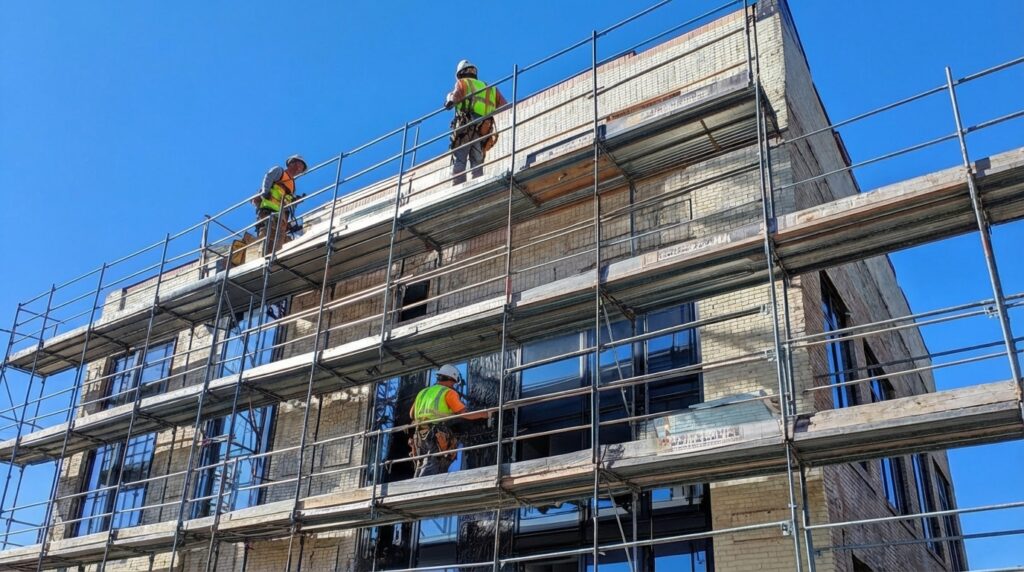
This is blog four in a series of five that I’ve written based on my experience leading remediation projects at Context. Having steered many complex projects through completion, I know the real pressure hits after the contract is signed. Successfully remediating occupied buildings requires more than technical skill, it demands rigorous governance and empathy for the residents living through it. Here is my roadmap for navigating the ‘discovery gap’ and protecting your community during delivery.
Author: Craig Birch, Principal at Context Architects.
Outline
- Moving from decision paralysis to disciplined project execution
- Defining the four critical phases of the delivery roadmap
- Managing the “discovery gap” once cladding is removed
- Governance structures to control variations and budget blowouts
- Mitigating resident disruption in occupied building sites
- Integrating betterment upgrades during the remediation phase
- The role of architectural-led diagnostics in delivery success
Key Takeaways
- Execution risk often exceeds initial decision risk
- Unknown defects require robust provisional sum management
- Resident communication is as critical as construction methodology
- Governance requires a disciplined Project Control Group structure
- Digital baselines prevent disputes over pre-existing conditions
- Compliance upgrades can trigger complex scope changes
- Professional independence protects the Body Corporate’s liability
Introduction
The moment a Body Corporate Committee signs a remediation contract, the psychological pressure shifts instantly. You move from the anxiety of “making the right decision” to the acute stress of “managing the execution.” For Chairpersons and Body Corporate Managers, this transition is profound. You are no longer debating theory or financial models; you are now responsible for a live construction site that also happens to be people’s homes.
In New Zealand, the complexity of remediating multi-unit developments – particularly those built during the monolithic cladding era – is compounded by the fact that these buildings usually remain occupied. This creates a unique friction between heavy industrial work and the statutory right to “quiet enjoyment” under the Residential Tenancies Act.
Furthermore, the physical reality of the building often diverges from the initial plans. As layers are peeled back, the “discovery gap” opens up. Rot, passive fire deficiencies, or structural anomalies that were hidden for decades suddenly become urgent, expensive line items.
This article provides a practical roadmap for navigating this high-stakes phase. It moves beyond the “what” of remediation to the “how” of delivery, focusing on governance, risk management, and maintaining social licence with your residents throughout the journey.
The Delivery Roadmap: Sequencing for Success
Successful remediation is not a linear construction task; it is a complex programme of works that requires rigorous sequencing. Treating it as a standard repair job is the fastest route to budget overruns. Instead, distinct phases must be respected to maintain control.
Phase 1: Triage and Diagnostic Confirmation
Before a single scaffold is erected, the scope must be stress-tested. In many failed projects, the scope was based on visual inspections that missed deep-seated decay. The delivery phase should begin with a “Digital Diagnostic” or comprehensive validation stage. This involves confirming the “known-unknowns” – defining exactly what assumptions have been made about timber condition, steel fixings, and fire stopping. This is the time to establish a digital baseline of the asset’s condition, ensuring that existing damage is recorded so contractors cannot claim it as damage caused during works (or vice versa
Phase 2: Funding and Consent Alignment
Delivery cannot proceed faster than the cash flow allows. Large unit title developments (10+ units) facing 30-year Long-Term Maintenance Plan (LTMP) obligations often use complex funding mixes, involving special levies and Body Corporate loans. The delivery roadmap must align construction milestones with draw-down facilities. If a lender requires a specific certification before releasing funds, the project programme must reflect that hold-point.
Phase 3: Procurement and Risk Transfer
Selecting a contractor is not just about price; it is about risk allocation. Standard construction contracts often penalise the client for “latent conditions” (hidden defects). A robust procurement strategy ensures that the risk of discovery is shared or managed through adequate Provisional Sums (often recommended at 20% or higher for complex remediation). This phase establishes the “rules of engagement” for how variations will be priced and approved.
Phase 4: Delivery Governance
This is the longest phase, often spanning 12 to 24 months for large complexes. It requires a formal governance structure, typically a Project Control Group (PCG), separate from the standard Committee meeting. The PCG focuses solely on time, cost, quality, and safety, preventing the standard Committee agenda from being swallowed by construction minutiae.
Managing the “Discovery Gap” and Variations
The greatest financial risk during implementation is the “Discovery Gap.” This occurs when the contractor removes the cladding or roof membrane and discovers damage that exceeds the initial reports. In New Zealand’s leaky building context, opening up a wall often reveals not just decayed timber, but failures in fire separations or structural steel corrosion that were impossible to see non-invasively
The Variation Trap
When these discoveries occur, they trigger “Variations to Contract.” If not managed, these can kill a project’s budget.
- The Wrong Way: The contractor finds rot, fixes it, and sends a bill at the end of the month. The Committee has no control and is blindsided by the cost.
- The Right Way: A strict Variation Protocol is enforced. No work proceeds on a variation until it is photographed, quantified, priced, and approved by the Engineer to Contract or the PCG (depending on the dollar value).
The Role of Provisional Sums
A healthy budget includes significant allowances for these unknowns. It is vital to communicate to owners that these funds exist to be spent. If they are not used, it is a bonus, but they are not “savings” to be banked before the project ends. Reporting on the “burn rate” of these provisional sums is a key governance duty.
Resident Disruption: A Project Stream, Not an Afterthought
In an occupied building, the residents are effectively living inside a factory. Managing their experience is as critical as managing the waterproofing. Disruption manifests in three ways: noise, access, and loss of amenity (such as carparks or balconies).
Communication Cadence
Information vacuums breed hostility. If residents do not know when the jackhammering will start, they cannot plan their lives. A “no-surprises” policy is essential. This involves:
Weekly Look-Aheads: Simple notices explaining high-noise activities planned for the week.
The “Single Source of Truth”: Utilizing a digital portal where all notices, timelines, and safety protocols are stored. This prevents the “he-said-she-said” confusion that plagues email chains.
Safety and Separation
Strict physical separation between construction zones and resident zones is non-negotiable. This is a Health and Safety at Work Act (HSWA) requirement. The Body Corporate, as the Person Conducting a Business or Undertaking (PCBU), shares liability. You must ensure that the contractor’s Site Specific Safety Plan (SSSP) clearly delineates resident pathways from hazard zones
Integrating “Betterment” During Remediation
While the primary driver is often weathertightness or seismic restraint, the delivery phase is the only cost-effective time to implement “betterment.””
The “Once in a Generation” Opportunity
When scaffolding is up and cladding is off, the marginal cost of upgrading insulation or windows is significantly lower than doing it as a standalone project.
Aesthetic Rejuvenation: Replacing dated monolithic textures with modern profiled metal or panelised systems does not just fix the leak; it repositions the asset in the market, driving the “Resilient Premium” that recovers capital value.
H1 Energy Efficiency: The Building Code now demands higher thermal performance. Retrofitting high-grade insulation and double glazing during remediation can solve the “overheating paradox” (where apartments are too hot in summer and cold in winter) and future-proof the asset against 2030 energy certificate mandates.
Why an Architectural-Led Approach Matters in Delivery
This roadmap highlights that remediation is not merely a trade-based repair job. It is a complex integration of structure, fire, weatherproofing, and liveability. Relying solely on a builder to manage this design coordination often leads to “trade conflicts”—where the plumber drills a hole through the waterproofer’s tanking because no integrated model existed to stop them.
This is where the Context Apartment Complex Building Retrofit & Remediation offering creates value. By moving from a “blind” consulting model to a productised, technology-led service, we shift the focus from reactive firefighting to proactive asset management.
The Context Difference in Stage 4
Our methodology is designed to handle the specific pressures of implementation:
Frequently Asked Questions
How long does apartment remediation typically take in NZ?
For comprehensive remediation of large complexes (10+ units), timelines often range from 12 to 24 months. This depends heavily on whether the building remains occupied and if staging is required to manage cash flow or accommodation.
How do we manage variations and surprises during works?
The best defence is a rigorous Stage 1 diagnostic to minimise unknowns, followed by a strict contract administration process. Variations should only be approved if they are verified by an independent Engineer to Contract, evidenced by photos, and tracked against provisional sums in a real-time risk register.
How do we keep residents safe during remediation?
Safety is a shared legal duty. The contractor must provide a Site Specific Safety Plan (SSSP) that segregates work zones from resident access. The Body Corporate should receive independent safety audits throughout the build to ensure these protocols are being followed.
What should a Body Corporate project governance structure include?
You should establish a Project Control Group (PCG) comprising the Chair, a Body Corporate Manager, and your independent professional advisors (Architect/Project Manager). The PCG should meet monthly to review the “traffic lights” of time, cost, and quality, separate from general committee business.
Next Steps
If your Committee is approaching the delivery phase, do not wait for the contract signing to establish your governance rules. The success of the next two years depends on the structures you set up today.
- Establish your PCG: distinct from the general committee, with a mandate to make rapid decisions within agreed financial delegations.
- Review your variation protocols: ensure you have an independent advisor to verify costs before you agree to them.
- Audit your resident communications plan: move beyond email to a centralised, transparent platform.
Governance failure during construction is expensive. Governance success protects your time, your sanity, and your asset’s value.
How do I get started with Apartment Complex Building Retrofit & Remediation?
Contact us today to discuss how Context Architects Ltd Apartment Complex Building Retrofit & Remediation deliver real business outcomes Contact Context
Jump to the other blogs in this series here:
- Blog 1 – Building Remediation: Why “Patch and Repair” Can Make Things Exponentially Worse
- Blog 2 – Building Remediation: How to Build a Business Case Owners Can Say Yes To
- Blog 3 – Building Remediation: How to Choose the Right Investigation Before You Choose a Solution
- Blog 5 – Building Remediation: After Handover – How to Maintain Compliance and the Resilient Premium for 30 Years
About the Author

Craig Birch, Principal at Context Architects
Craig Birch is a specialist in navigating the complex intersection of building remediation and asset governance. With deep experience guiding Committees through the high-stakes environment of “leaky building” remediation and seismic strengthening, Craig understands that these projects are not just about construction – they are about financial survival and community consensus.
He works daily with Body Corporate Chairs and Asset Managers to move beyond the “patch and repair” cycle, advocating for data-led strategies that protect owner solvency and restore long-term asset value. Craig is passionate about replacing the anxiety of “unknowns” with the certainty of evidence, helping owner groups transform distressed liabilities back into resilient, insurable, and saleable homes.